TEST-2 Several test points on one net (incl. through 0R), unless top and bottom
| Severity | Status | Implementation |
|---|---|---|
| suggestion | runs in better_erc | easy, depends on netlist, IMP-5 |
Data it needs: graph, part classes, values.
Looks at. Test points per net, 0 Ω links, board side (PnP, IMP-5).
What it catches. Two or more test points on the same net, counting nets joined by a 0 Ω resistor or a net tie, unless they sit on opposite sides of the board.
Why it matters. Duplicate test points waste board area and fixture probes, and they often hide a copy-paste: two pads labelled the same while a neighbouring net got none. One per side is legitimate: a bed-of-nails fixture probes the bottom, a person at the bench the top.
Example. TP3 and TP7 both on +3V3 (one copied with a power block from another sheet), while +1V8 has no test point at all (TEST-4).
How to check. Group test points by net, merging nets joined by 0 Ω parts; more than one per group and side is a finding. The side comes from the PnP file (IMP-5) or the footprint layer.
Fix. Keep one per side; move the spare to a net that has none.
References. Wikipedia, In-circuit testing (bed of nails probes from one side); PCBCart TP.
Test schematics
Each schematic below is in test_schematics/sources. The block under it is what berc check --only TEST-2 reports on it.
test-2_duplicate_test_points
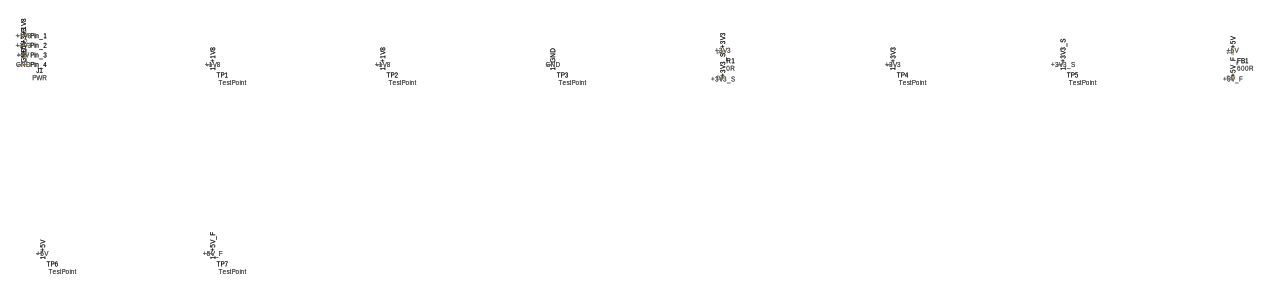
  suggestion TEST-2 #x94    2 test points TP1 and TP2 on +1V8 (estimate)
                            net +1V8, part TP1, part TP2
                            side = not known (assumed no layout: the test points counted as on one side)
                            fix: keep one per side; move the spare to a net that has none (TEST-4)
  suggestion TEST-2 #m8j    2 test points TP4 and TP5 on +3V3 and +3V3_S (estimate)
                            net +3V3, net +3V3_S, part TP4, part TP5
                            side = not known (assumed no layout: the test points counted as on one side)
                            fix: keep one per side; move the spare to a net that has none (TEST-4)