BOM-4 Propose consolidating identical resistors into resistor networks
| Severity | Status | Implementation |
|---|---|---|
| suggestion | runs in better_erc | easy, depends on IMP-6 |
Data it needs: graph, part classes, values.
Looks at. Values (IMP-6), which resistors share a part or a bus.
What it catches. Groups of identical resistors (same value, same package) that sit on pins of one part or one bus and could be one array.
Why it matters. Four 0402 pull-ups are four placements; one 4-element array is one, with a smaller footprint and fewer joints. It is a trade-off, not a rule: arrays come in fewer values, make single-resistor rework harder, and couple the elements thermally.
Example. Eight 10 kΩ pull-ups on a parallel bus next to an MCU: two Bourns CAT16-103J4LF arrays (4 isolated elements, 1206 size) replace them.
How to check. Identical resistors whose one end goes to pins of the same part (or the same connector) and whose other end is shared (a rail) or free. better_erc (erc_checks/src/bom/bom_4.rs) looks at fitted two-pin resistors of one value and case whose one end is on signal pins of the same IC or connector (one resistor per net, not a supply net) and whose other ends share a net (pull-ups) or are all apart (series resistors). A group inside a bigger one is the bigger one's finding.
A group becomes a finding only when an array would really replace it, which takes three conditions:
- The group has at least
min_groupresistors (4 by default). Two resistors save one placement, which rarely pays for a less common part. - A common isolated array holds the value and case size. The table below lists what several makers stock; a value outside the E24 series or outside 10 Ω to 1 MΩ, or a case size not in the table, gets no finding.
- With a layout (
.kicad_pcb), the resistors sit withinspread_max(10 mm by default) of each other, centre to centre. Only the largest set that does counts; it must still reachmin_group. Without a layout, the finding says that placement was not checked.
| Element case | Elements | Values | Examples |
|---|---|---|---|
| 0201 | 2, 4 | E24, 10 Ω to 1 MΩ | Panasonic EXB14V, EXB18V |
| 0402 | 2, 4 | E24, 10 Ω to 1 MΩ | Panasonic EXB24V, EXB28V |
| 0603 | 2, 4 | E24, 10 Ω to 1 MΩ | Panasonic EXB34V, EXB38V; Bourns CAT16 |
The table is kept small on purpose: it lists only what more than one maker offers in the common value series. Arrays of 8 elements and 0805 elements exist but are rarer, so the check does not propose them.
For example, four 10 kΩ 0402 pull-ups from one MCU to +3V3, placed 2 mm apart, give "1 × 4-element 0402 array instead of 4 placements". The same four resistors 20 mm apart give no finding, and so do four 10.2 kΩ resistors, because 10.2 kΩ is an E96 value.
| Setting | Default | Meaning |
|---|---|---|
min_group |
4 | the smallest group worth an array |
spread_max |
10 mm | how far apart the resistors of a group may sit on the board |
Both are set under [checks."BOM-4"] in the project file.
Fix. The finding names the arrays that place the group, for example "1 × 4-element 0402 array and 1 discrete". Use isolated-element arrays where the routing allows; keep discrete parts where rework or precision matters.
References. Panasonic, Chip Resistors Array, EXB type (1 Mar 2020, document AOC0000C14): sizes, element counts and the 10 Ω to 1 MΩ E24 range at ±5 % (industrial.panasonic.com). Samsung Electro-Mechanics, Chip Resistor catalogue (Mar 2022): 0201 and 0402 element arrays of 2 and 4, 10 Ω to 1 MΩ. Bourns, CAT/CAY16 Series - Chip Resistor Arrays (2, 4 or 8 isolated elements, "How To Order") (bourns.com/docs/Product-Datasheets/CATCAY.pdf).
Settings
Set them in the project file under [checks."BOM-4"], or for one run with --set BOM-4.NAME=VALUE.
| Setting | Default | Meaning |
|---|---|---|
BOM-4.min_group |
4 parts | the smallest group of identical resistors worth an array (common arrays hold 2 or 4 elements) |
BOM-4.spread_max |
10 mm | how far apart on the board the resistors of a group may sit, centre to centre, to share an array |
Test schematics
Each schematic below is in test_schematics/sources. The block under it is what berc check --only BOM-4 reports on it.
bom-4_placement
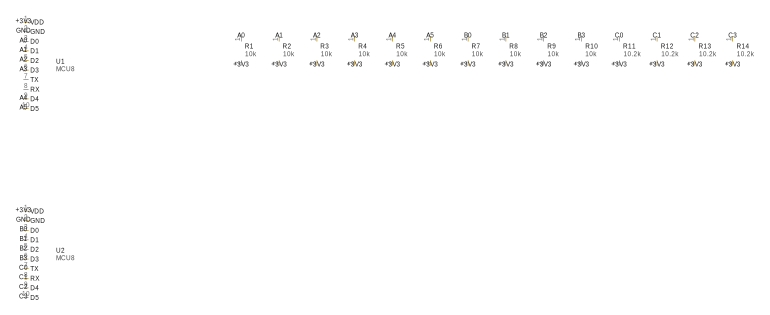
  suggestion BOM-4 #pc6     4 × 10 kΩ 0402 (R1, R2, R3, R4) between U1 and /+3V3, placed within 10 mm of each other: 1 × 4-element 0402 array instead of 4 placements
                            net /+3V3, part R1, part R2, part R3, part R4
                            min_group = 4 (derived BOM-4 default)
                            spread_max = 10 mm (derived BOM-4 default)
                            fix: 0402 isolated resistor arrays (Panasonic EXB class) where the routing allows; keep discrete parts where rework or precision matters
bom-4_resistor_arrays
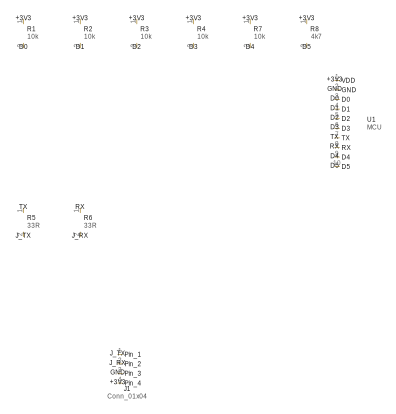
  suggestion BOM-4 #6rv     4 × 10 kΩ 0402 (R1, R2, R3, R4) between U1 and /+3V3; placement not checked (no layout): 1 × 4-element 0402 array instead of 4 placements
                            net /+3V3, part R1, part R2, part R3, part R4
                            min_group = 4 (derived BOM-4 default)
                            spread_max = 10 mm (derived BOM-4 default)
                            fix: 0402 isolated resistor arrays (Panasonic EXB class) where the routing allows; keep discrete parts where rework or precision matters