CLK-14 Reset input driven by a push-pull output¶
| Severity | Status | Implementation |
|---|---|---|
| warning | runs in better_erc | easy, depends on IMP-1, NET-7 |
Data it needs: graph, part classes, rails.
Looks at. Pin types of the drivers on reset nets.
What it catches. A reset net driven by a push-pull output (a GPIO, a supervisor with push-pull output) together with any other driver: a debugger, a button, the MCU's own NRST, a second supervisor.
Why it matters. Reset lines are wired-OR: several sources pull low, one pull-up lets go. The STM32's NRST is itself an output: internal reset sources drive the pin low through a pulse generator for at least 20 µs (AN5096 §1.3.2). A push-pull output holding the line high fights that, the debugger's reset and the button, and the reset either does not happen or the drivers heat.
Example. A supervisor with push-pull RESET output (a TPS3823; only the TPS3828 of that family is open drain, TPS3823 §7.3.3) on the MCU's NRST and the SWD connector's nRESET: the probe's reset never gets the line low, and every watchdog reset of the MCU shorts its NRST driver into the supervisor's high output.
How to check. Reset nets (IMP-1 names) with an output (push-pull) pin and any other driver or a button; open drain is open_collector (IMP-1, NET-7 where the library is vague).
Fix. Open-drain sources only (supervisors with open-drain output, GPIOs in open-drain mode), or a series resistor where a push-pull source cannot be avoided.
References. AN5096 §1.3.2, §6.1.2; TPS3823 §7.3.3.
Test schematics¶
Each schematic below is in test_schematics/sources. The block under it is what berc check --only CLK-14 reports on it.
clk-14_push_pull_reset¶
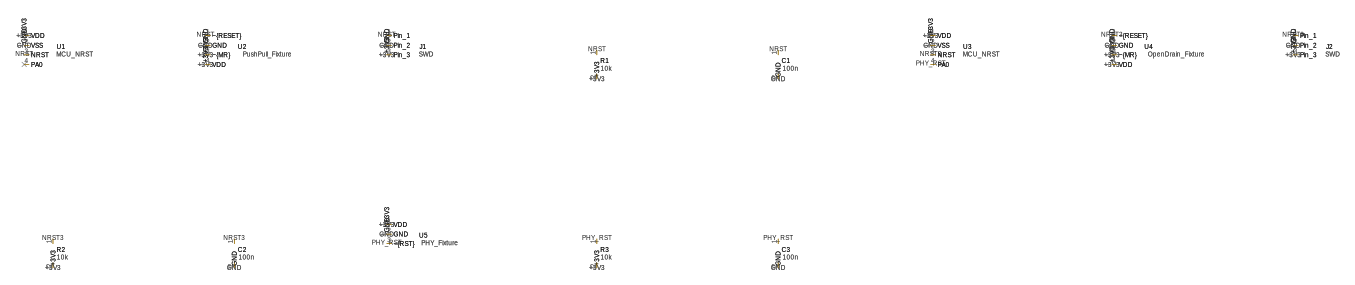
  warning    CLK-14 #mf0    U2.1 (~{RESET}) drives the reset net /NRST push-pull, against J1.1 (Pin_1) and U1.3 (NRST): a reset line is wired-OR, open-drain sources and one pull-up
                            net /NRST, pin U2.1
                            fix: an open-drain source (a supervisor with open-drain output, a GPIO in open-drain mode), or a series resistor where push-pull cannot be avoided