CLK-6 Suggest a cap on buttons to reset inputs; note hw debounce in the programmer report¶
| Severity | Status | Implementation |
|---|---|---|
| suggestion | runs in better_erc | easy, depends on IMP-1, RPT-13 |
Data it needs: graph, part classes, rails.
Looks at. Switch parts on reset nets.
What it catches. A reset button with no capacitor on the reset net.
Why it matters. A bouncing reset button gives a train of short resets; parts with a minimum reset pulse width (the USB251xB needs RESET_N low for at least 1 µs after its supplies are valid) may see a pulse too short to be a clean reset, and ESD from a finger lands directly on the pin.
Example. A reset button straight to NRST on a board with a 1 m cable to the button panel: every press gives a burst of resets and occasionally a half-reset peripheral.
How to check. Switches on reset nets (IMP-1) with no capacitor to ground on that net; report "hw debounce: yes/no" for the reset input in the programmer report (RPT-13).
Fix. 100 nF to ground on the reset net (with the pull-up, a ms-range time constant).
References. USB251xB §5.5.1 ww1.microchip.com/…/00001692C.pdf; AN5096 §6.1.2.
Test schematics¶
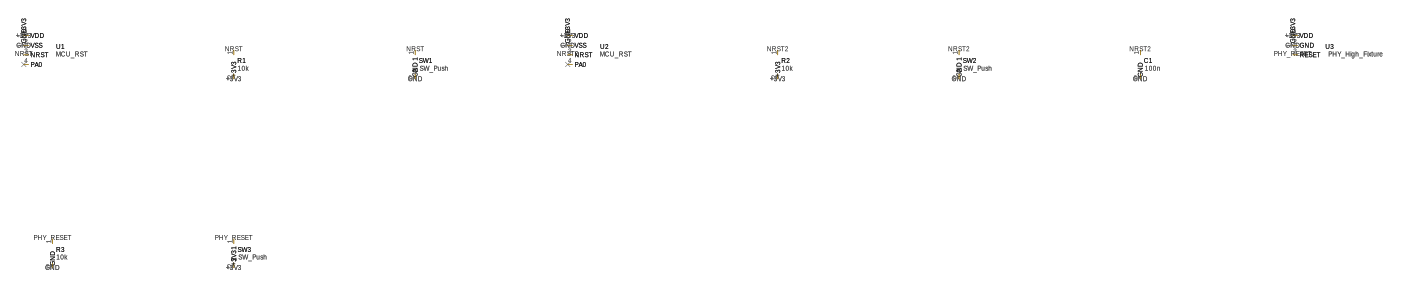
Each schematic below is in test_schematics/sources. The block under it is what berc check --only CLK-6 reports on it.
clk-6_reset_buttons¶