SHORT-6 Inputs shorted to ground or power without a resistor¶
| Severity | Status | Implementation |
|---|---|---|
| error | runs in better_erc | easy, depends on netlist (NET-7 to tell configurable pins |
Data it needs: graph, part classes, rails.
Looks at. Pin types, which pins can become outputs.
What it catches. An input or IO pin tied straight to a rail or ground with no resistor in between.
Why it matters. For a fixed-function CMOS input, a hard tie is fine. For a pin that can be an output (an MCU GPIO, an FPGA user IO, a boundary-scan pin, a configuration pin that is driven during boot), a hard tie becomes a short the moment the pin drives the opposite level: firmware sets it as output, the boot ROM toggles it, a JTAG EXTEST drives it. The pin's driver then sources 30-100 mA into the rail until it fails.
Example. An unused STM32 GPIO tied to GND "so it does not float". A later firmware maps an LED to that pin and drives it high: the pin sinks its short-circuit current, the port's IO current budget is gone, and the pin is degraded.
How to check. Pins of IO or bidirectional type, or input pins of parts with configurable IO (NET-7), whose net is a rail or ground with no series resistor (NET-10). A sense, set-point or discharge net named after its rail (VIO_S, VIO_SP, VIO_DISCH) is no rail: an ADC input on a divider or a DAC output there is the design. Such a name makes a rail again with a power pin, power symbol or regulator on the net.
Fix. Tie through 1-10 kΩ, or leave the GPIO unconnected and configure it as analog or output-low in firmware (LEAK-3).
References. Toshiba unused inputs (pins that can become outputs go through a resistor, never directly); TI SN74ACT17 datasheet SCASE32 §8.2.1.2 "Input Considerations" (ti.com); SDYA009 §3 "Unused Inputs"; SCBA004 §5.
Test schematics¶
Each schematic below is in test_schematics/sources. The block under it is what berc check --only SHORT-6 reports on it.
short-6_io_tied_to_rail¶


  error      SHORT-6 #8kk   U1.3 (PA0, bidirectional) is tied straight to the ground GND: a short when it drives the other level
                            net GND, part U1, pin U1.3
                            fix: tie through 1-10 kΩ, or leave it open and set it to analog or output-low in firmware (LEAK-3)
short-6_sense_nets¶
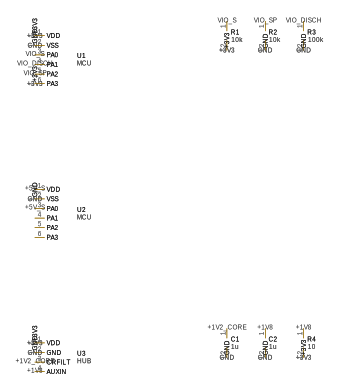
  error      SHORT-6 #7v2   U1.6 (PA3, bidirectional) is tied straight to the rail +3V3: a short when it drives the other level
                            net +3V3, part U1, pin U1.6
                            fix: tie through 1-10 kΩ, or leave it open and set it to analog or output-low in firmware (LEAK-3)
  error      SHORT-6 #5rk   U2.3 (PA0, bidirectional) is tied straight to the rail /+5V_S: a short when it drives the other level
                            net /+5V_S, part U2, pin U2.3
                            fix: tie through 1-10 kΩ, or leave it open and set it to analog or output-low in firmware (LEAK-3)
SHORT-6 also fires on the test schematics of other checks: dbg-7_internal_pull.