DBG-7 Suggest DNM pull-up and down on EN pins
| Severity | Status | Implementation |
|---|---|---|
| suggestion | runs in better_erc | easy, depends on netlist |
Data it needs: graph, part classes, rails.
Looks at. Enable pins (by name or NET-7), DNP flags.
What it catches. Enable pins of regulators, load switches and peripherals that are tied hard to a rail or driven from one place only, with no footprint to override the level.
Why it matters. At bring-up the first thing one wants is to power the board stage by stage: hold a regulator off to find which load shorts a rail, or force a switch on while the firmware that drives it does not exist yet. A pair of unpopulated pull-up and pull-down footprints does that with a dab of solder; without them it is a cut trace.
Example. A 1.8 V LDO whose EN is tied straight to its VIN: when the 1.8 V rail turns out shorted, the only way to tell whether the LDO or a load is at fault is lifting a pin.
How to check. Pins named EN, ON, SHDN and similar whose net is a rail directly, or a single driver, with no second resistor footprint on it. A pin left open with a permanent internal pull in the known-parts table (erc_analysis/src/internal_pull.rs: USB2514B PRTPWR/BC_EN, internal pull-down) is not reported; a driven or rail-tied pin of such a part still is.
Fix. Drive EN through a resistor (or from a GPIO with a pull, IO-3) and add a DNM resistor to the other level.
References. XJTAG DFT (pull resistors to define a default that a controller can override); the regulator's datasheet (EN thresholds and input current). Test schematic dbg-7_internal_pull (U1, U2).
Test schematics
Each schematic below is in test_schematics/sources. The block under it is what berc check --only DBG-7 reports on it.
dbg-7_enable_pulls
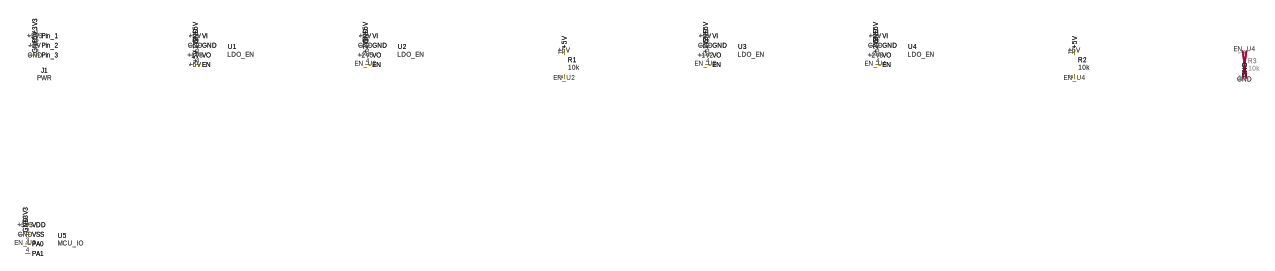
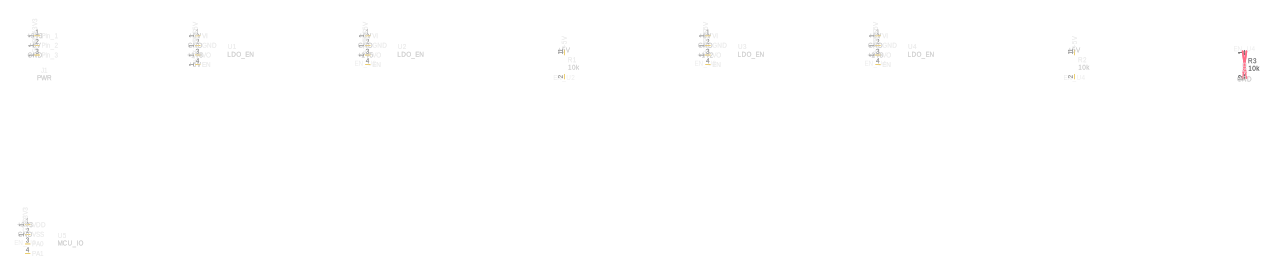
  suggestion DBG-7 #tfg     U1.4 (EN) tied to +5V
                            net +5V, pin U1.4
                            fix: drive EN through a resistor (or from a GPIO with a pull) and add a DNM resistor to the other level
  suggestion DBG-7 #b29     U2.4 (EN) pulled up by R1 with no footprint to pull it down
                            net /EN_U2, pin U2.4
                            fix: drive EN through a resistor (or from a GPIO with a pull) and add a DNM resistor to the other level
  suggestion DBG-7 #7pq     U3.4 (EN) driven by U5.3 (PA0) only
                            net /EN_U3, pin U3.4
                            fix: drive EN through a resistor (or from a GPIO with a pull) and add a DNM resistor to the other level
dbg-7_internal_pull
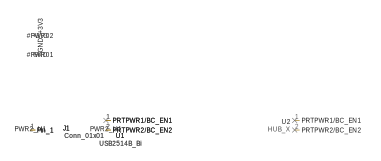
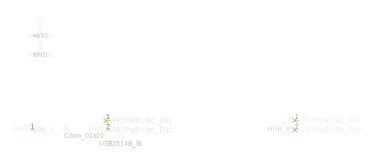
  suggestion DBG-7 #29y     U1.2 (PRTPWR2/BC_EN2) tied to /PWR2_U1
                            net /PWR2_U1, pin U1.2
                            fix: drive EN through a resistor (or from a GPIO with a pull) and add a DNM resistor to the other level
  suggestion DBG-7 #19e     U2.1 (PRTPWR1/BC_EN1) left with no pull either way
                            net unconnected-(U2-PRTPWR1{slash}BC_EN1-Pad1), pin U2.1
                            fix: drive EN through a resistor (or from a GPIO with a pull) and add a DNM resistor to the other level
  suggestion DBG-7 #2gz     U2.2 (PRTPWR2/BC_EN2) left with no pull either way
                            net unconnected-(U2-PRTPWR2{slash}BC_EN2-Pad2), pin U2.2
                            fix: drive EN through a resistor (or from a GPIO with a pull) and add a DNM resistor to the other level
DBG-7 also fires on the test schematics of other checks: clk-18_clock_fan_out, drv-5_inverter_gate_resistor, i2c-7_segments, logic-3_fan_out, logic-8_polarity, pin-3_unprotected_outputs, pin-4_unfused_inputs, short-11_output_conflict, short-2_name_collision, wire-2_similar_names.