CONN-10 Many pins and few grounds on a connector¶
| Severity | Status | Implementation |
|---|---|---|
| warning | runs in better_erc | easy, depends on NET-5 |
Data it needs: graph, part classes, rails.
Looks at. Connector pins, ground nets.
What it catches. A connector with many signal pins and only one or two grounds, or all grounds bunched at one end.
Why it matters. All return currents crowd onto the few ground pins: their shared inductance becomes common ground impedance, so every edge on one signal shows up as noise on all others (ground bounce through the connector), and the far signals have a large loop. It also leaves little current capacity on the return (CONN-6).
Example. A 40-pin 0.5 mm FPC to an RGB parallel display with one ground pin, the pixel clock at 30 MHz on the far end: the display shows sparkles on fast transitions. B200A's J102 has 9 grounds for 30 pins, spread across the ribbon.
How to check. Count ground pins against the signal pins per connector (NET-5), and the largest distance from a signal pin to the nearest ground in pin order; report ratios below about 1 ground per 4-6 signals for fast interfaces.
Fix. More grounds, spread between the signal groups; for fast interfaces one per pair or per two to three single-ended lines (CONN-5).
References. Johnson & Graham §9.1, §9.5 (continuity of ground underneath a connector), chapter 10; Ott §2.16.
Settings¶
Set them in the project file under [checks."CONN-10"], or for one run with --set CONN-10.NAME=VALUE.
| Setting | Default | Meaning |
|---|---|---|
CONN-10.min_signals |
10 pins | a connector with fewer signal pins is not judged |
CONN-10.max_signals_per_ground |
6 pins | signal pins per ground pin above this are too few grounds |
CONN-10.max_distance |
8 pins | a signal pin further than this from the nearest ground in pin order has a large loop |
Test schematics¶
Each schematic below is in test_schematics/sources. The block under it is what berc check --only CONN-10 reports on it.
conn-10_few_grounds¶
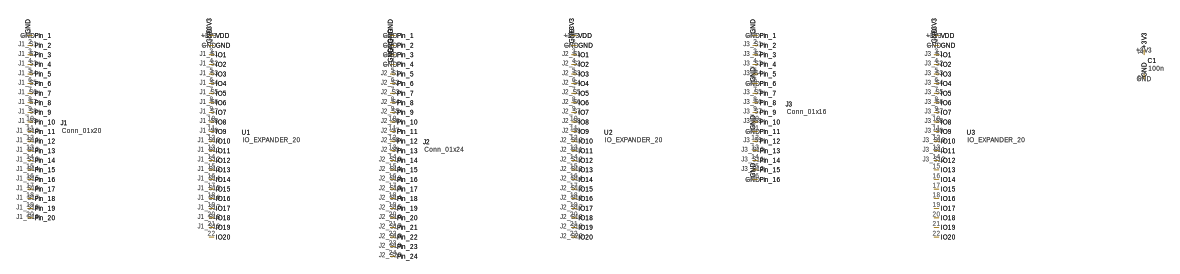
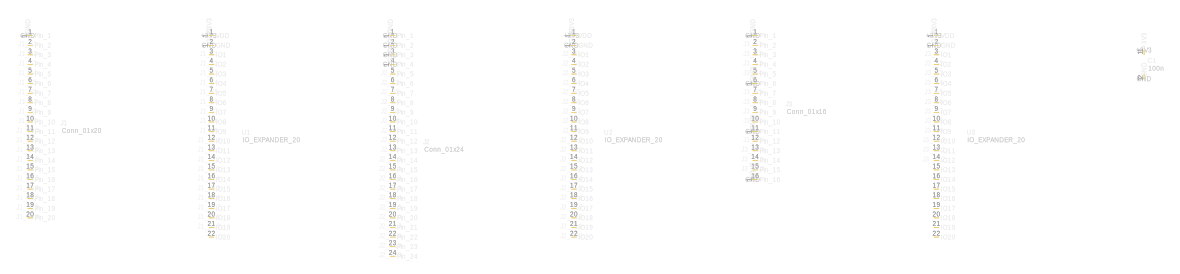
  warning    CONN-10 #vbv   connector J1: 19 signal pins on 1 ground (19.0 per ground); pin 20 is 19 pins from the nearest ground: every edge shows up as ground bounce on the others, and the far signals have a large loop
                            part J1
                            max_signals_per_ground = 6 (derived CONN-10 default)
                            max_distance = 8 (derived CONN-10 default)
                            fix: more grounds, spread between the signal groups; for fast interfaces one per pair or per two to three single-ended lines (CONN-5)
  warning    CONN-10 #s9t   connector J2: pin 24 is 20 pins from the nearest ground: every edge shows up as ground bounce on the others, and the far signals have a large loop
                            part J2
                            max_signals_per_ground = 6 (derived CONN-10 default)
                            max_distance = 8 (derived CONN-10 default)
                            fix: more grounds, spread between the signal groups; for fast interfaces one per pair or per two to three single-ended lines (CONN-5)