I2C-1 No pull-ups on an I2C bus¶
| Severity | Status | Implementation |
|---|---|---|
| error | runs in better_erc | easy, depends on NET-4, NET-5 |
Data it needs: graph, part classes.
Looks at. The bus (SCL/SDA nets), resistors to a rail.
What it catches. An SCL or SDA net with no resistor to a power rail anywhere on the bus.
Why it matters. I2C drivers are open-drain: every device can only pull a line low. Without a pull-up nothing ever pulls it high, so the bus reads a permanent low (or floats, if a master uses its internal pulls) and no transfer completes. Boards "with an I2C sensor that is never found" very often have the pull-ups on a daughterboard that was assumed, or a DNP footprint nobody populated.
Example. A sensor board designed to hang off a Raspberry Pi header: the designer relies on the Pi's 1.8 kΩ pull-ups. Plugged into an MCU board without them, the sensor is dead. The reverse happens too: a module with its own pull-ups removed "to save power".
How to check. Follow each SCL/SDA net through series resistors and switches to the full bus segment; look for a resistor whose other end is a rail (NET-5). Internal pull-ups of masters count only when the project says so (they are typically 30-50 kΩ and too weak, see I2C-8).
Fix. One pull-up pair per bus segment, to the IO rail of the devices on it (LVL-4); value per I2C-8/I2C-9.
References. UM10204 §7.1 (pull-up resistor sizing); SLVA689; SLVA704 §2; Wikipedia, I²C "Physical layer".
Test schematics¶
Each schematic below is in test_schematics/sources. The block under it is what berc check --only I2C-1 reports on it.
i2c-1_no_pull_ups¶
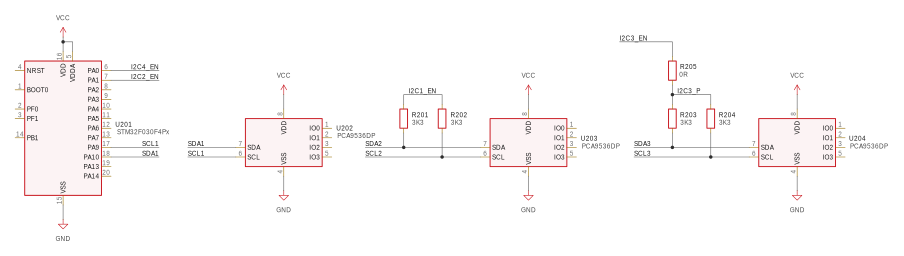
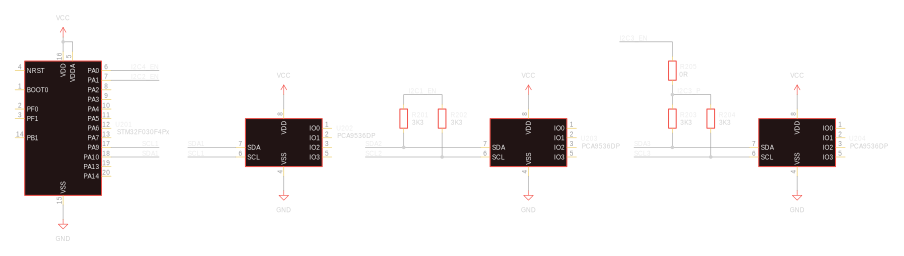
  error      I2C-1 #e6r     I2C bus /I2C1: no pull-ups on SCL and SDA
                            net /SCL1, net /SDA1
                            fix: one pull-up pair per bus segment, to the IO rail of the devices on it
I2C-1 also fires on the test schematics of other checks: conn-8_micro_hdmi_pinout.