I2C-4 Pull-up to a non-rail net¶
| Severity | Status | Implementation |
|---|---|---|
| error | runs in better_erc | easy, depends on NET-4, NET-5 |
Data it needs: graph, part classes, rails.
Looks at. The bus, power structure.
What it catches. A pull-up whose far end is a net that is not a power rail (a signal, an enable, a net with only this resistor on it).
Why it matters. Usually a label typo (+3V3 vs 3V3) or a pull-up wired to an "I2C_EN" GPIO so the firmware can switch it: then the bus only works after that GPIO is driven, which the ROM bootloader and early firmware do not do, and the GPIO's current limit becomes the bus's.
Example. On B153A the SDA pull-up R301 went to I2C_EN (PA4) while SCL's R302 went to 3.3 V, so the hub was only reachable once firmware set PA4; the hub in fact works with both lines simply pulled up, and the pin was freed in rev B.
How to check. The far end of each pull-up must be a rail of the power structure (NET-5); a two-pin net there is the clearest sign. A strap-gated bus is info, not an error: the far end is a push-pull output of an MCU, SoC or FPGA (pin type output, or a chosen alternate such as PF0/PP), and the bus lines also have pull-downs to ground. The pull-downs are straps the bus parts read while the GPIO is low (USB2514B CFG_SEL, NON_REM on B153B); the GPIO then enables the bus. Without pull-downs, or with another driver on the far end, it stays an error.
Fix. Pull to the rail; if a switched pull-up is really wanted, use a proper bus switch or a FET with a documented default (IO-3).
References. UM10204 §7.1; B153 rev B change list (R301).
Settings¶
Set them in the project file under [checks."I2C-4"], or for one run with --set I2C-4.NAME=VALUE.
| Setting | Default | Meaning |
|---|---|---|
I2C-4.max_feed |
100 Ω | the largest series resistor that still feeds a rail (an RC filter, a shunt) |
Test schematics¶
Each schematic below is in test_schematics/sources. The block under it is what berc check --only I2C-4 reports on it.
i2c-4_gpio_pull_ups¶
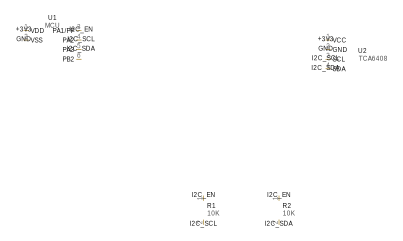
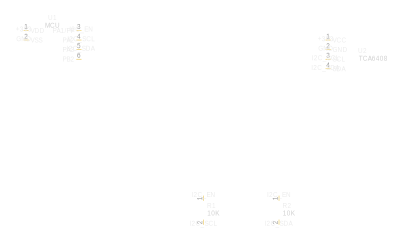
  error      I2C-4 #42f     I2C bus /I2C_I2C: pull-ups R1 and R2 go to /I2C_EN, which is no rail: the bus works only once something drives it high
                            net /I2C_EN, net /I2C_SCL, net /I2C_SDA, part R1, part R2
                            fix: pull up to the rail; a switched pull-up wants a bus switch or a FET with a documented default (IO-3)
i2c-4_pull_up_to_signal¶
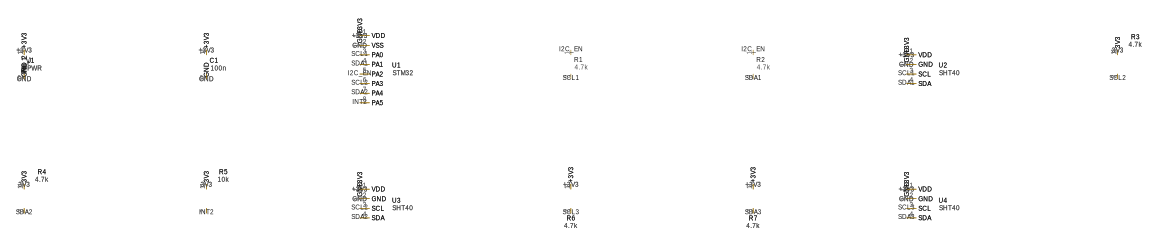
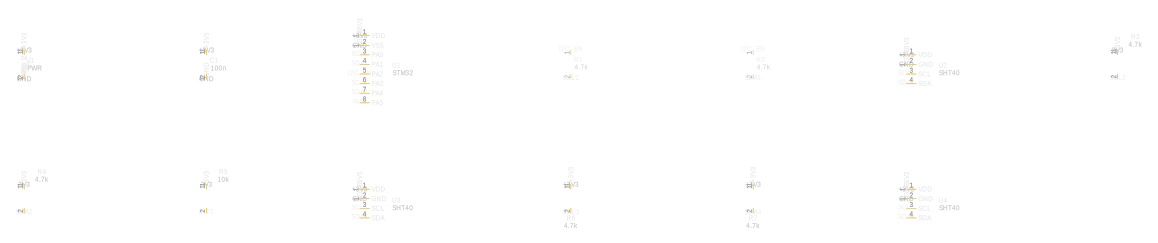
  error      I2C-4 #k2q     I2C bus /I2C1: pull-ups R1 and R2 go to /I2C_EN, which is no rail: the bus works only once something drives it high
                            net /I2C_EN, net /SCL1, net /SDA1, part R1, part R2
                            fix: pull up to the rail; a switched pull-up wants a bus switch or a FET with a documented default (IO-3)
  error      I2C-4 #nxn     I2C bus /I2C2: pull-ups R3 and R4 go to 3V3, a rail by its name that holds only resistors and that no source reaches: the bus works only once something drives it high
                            net /SCL2, net /SDA2, net 3V3, part R3, part R4
                            fix: pull up to the rail; a switched pull-up wants a bus switch or a FET with a documented default (IO-3)
i2c-4_strap_gated_bus¶
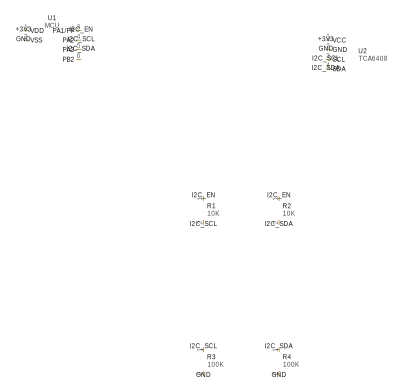
  info       I2C-4 #a32     I2C bus /I2C_I2C: pull-ups R1 and R2 go to /I2C_EN, driven by push-pull U1.3, with pull-downs R3, R4 on the lines: a strap-gated bus, idle only once the GPIO is high
                            net /I2C_EN, net /I2C_SCL, net /I2C_SDA, part R1, part R2, pin U1.3
                            fix: drive the GPIO high before the bus is used, and note it in the firmware's pin setup
I2C-4 also fires on the test schematics of other checks: i2c-7_segments.