I2C-7 Series tie resistor too high¶
| Severity | Status | Implementation |
|---|---|---|
| warning | runs in better_erc | easy, depends on NET-4, NET-10 |
Data it needs: graph, part classes, values.
Looks at. The bus, series resistors.
What it catches. A series resistor in an SCL or SDA line (a net tie, a 0 Ω selector, an ESD resistor) above about 100 Ω.
Why it matters. Series resistance adds to the open-drain driver's output impedance: the low on the far side is VOL plus IOL × R, and with the pull-up it forms a divider. A few hundred ohms with a 3 mA sink already lifts the low by a volt. It also slows the falling edge together with the far side's capacitance.
Example. A 1 kΩ "protection" resistor in SDA towards an off-board sensor: the far-side low sits at ~1.4 V with a 2.2 kΩ pull-up on 3.3 V, above the 0.3·VDD = 0.99 V threshold; the sensor never sees a low.
How to check. Series resistors on the bus lines (NET-10) with a value over the check's max_tie threshold (100 Ω by default).
Fix. 0 Ω ties, or protection with a TVS instead of a resistor; if a resistor is needed keep it ≤ 100 Ω and recompute VOL.
References. UM10204 §7.3 (series protection resistors), Table 10 (VOL, IOL); SLVA704 §4.
Settings¶
Set them in the project file under [checks."I2C-7"], or for one run with --set I2C-7.NAME=VALUE.
| Setting | Default | Meaning |
|---|---|---|
I2C-7.max_tie |
100 ohm | highest resistance of a series tie in an SCL or SDA line |
Test schematics¶
Each schematic below is in test_schematics/sources. The block under it is what berc check --only I2C-7 reports on it.
i2c-7_segments¶
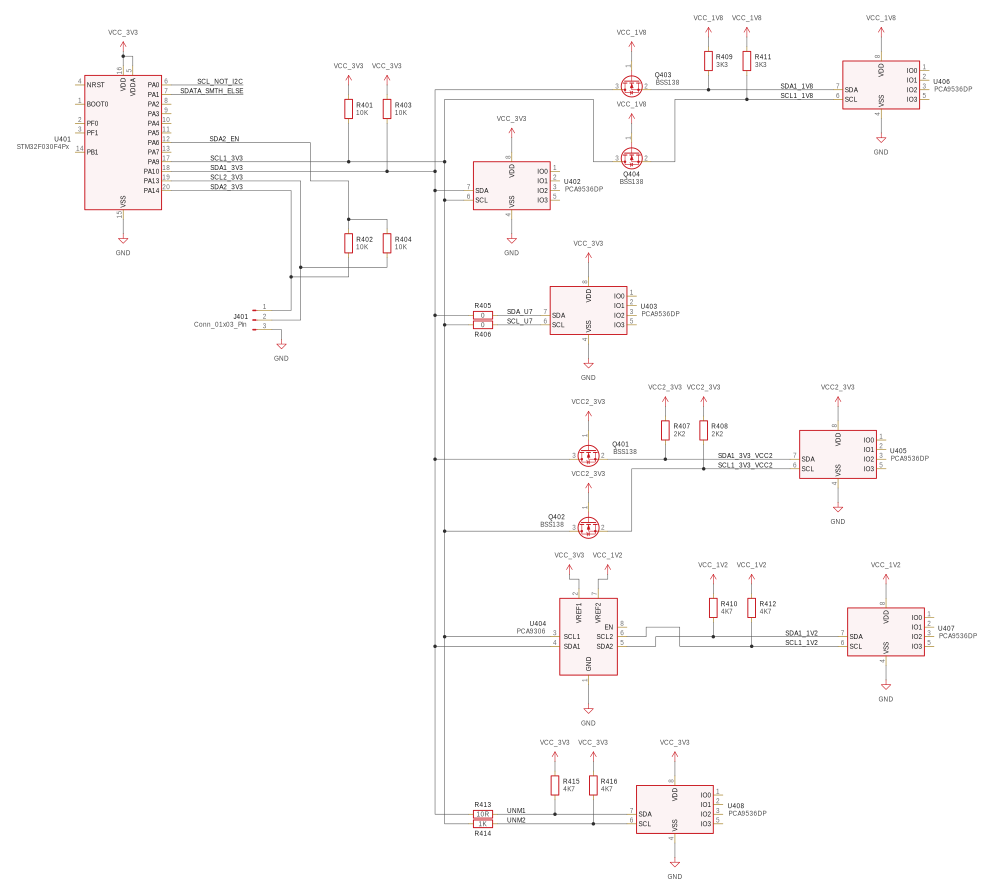
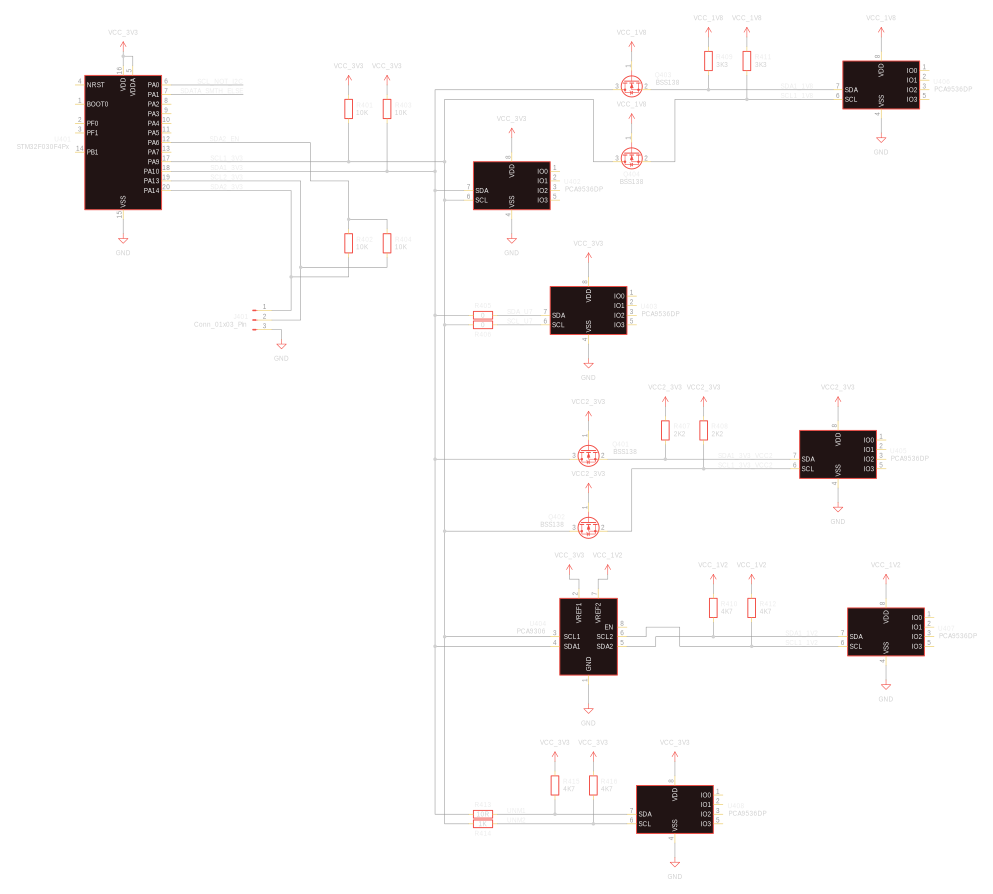
  warning    I2C-7 #38w     I2C bus /I2C1_3V3 to /I2C1_3V3_to_U408: tie R414/R413 is 1 kΩ, over 100 Ω
                            net /SCL1_3V3, net /SDA1_3V3, net /UNM1, net /UNM2, part R413, part R414
                            R414 = 1 kΩ (sch i2c-7_segments.kicad_sch)
                            R413 = 10 Ω (sch i2c-7_segments.kicad_sch)
                            max_tie = 100 Ω (derived I2C-7 default)
                            fix: 0 Ω ties; for protection a TVS, not a resistor