NAME-9 IO numbering out of order against the part's pins¶
| Severity | Status | Implementation |
|---|---|---|
| suggestion | runs in better_erc | easy, depends on netlist |
Data it needs: graph, part classes.
Looks at. Net names with numbers, MCU pin names (GPIO numbers).
What it catches. A numbered set of nets (IO0-IO7, LED1-LED4, CH0-CH3) whose order differs from the order of the MCU pins they land on, where the pins are otherwise consecutive.
Why it matters. Firmware loves consecutive pins: a PIO program, a port write, a DMA to a GPIO register moves a block of pins at once. One swapped pair forces a lookup table or breaks the block, and the swap is invisible on the sheet unless the names and the pins are compared.
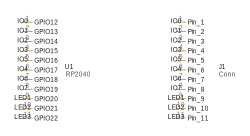
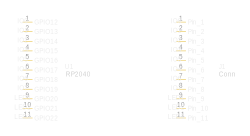
Example. On B200A IO0-IO3 sit on GPIO12-GPIO15 and IO6-IO7 on GPIO18-GPIO19, but IO4 is on GPIO17 and IO5 on GPIO16: swapped against GPIO order, which matters for PIO programs that use consecutive pins. The rev B change list puts them back in order.
How to check. For net families with a numeric index, map each to the GPIO number of the MCU pin it reaches (from the pin name); report families whose GPIO numbers are monotonic except for a swap.
Fix. Swap the nets at the MCU (or rename them) so the order matches.
References. B200A schematic review §6 (IO4/IO5 swapped against GPIO order); B200 rev B change list.
Settings¶
Set them in the project file under [checks."NAME-9"], or for one run with --set NAME-9.NAME=VALUE.
| Setting | Default | Meaning |
|---|---|---|
NAME-9.min_family |
3 | the fewest nets of one numbered family on one part's GPIOs that are compared |
Test schematics¶
Each schematic below is in test_schematics/sources. The block under it is what berc check --only NAME-9 reports on it.
name-9_io_order¶