ANA-12 Comparator on a slow or noisy signal without hysteresis
| Severity | Status | Implementation |
|---|---|---|
| suggestion | runs in better_erc | easy, depends on netlist |
Data it needs: graph, part classes.
Looks at. Comparator parts and their feedback.
What it catches. A comparator (or an op-amp used as one) with no positive feedback resistor from the output to the non-inverting input, no built-in hysteresis, fed from a slow or noisy signal.
Why it matters. Near the threshold the input spends a long time within millivolts of the reference; noise and the comparator's own output edge coupling back through the supply make it toggle many times per crossing. A battery-low flag chatters, an interrupt fires a thousand times, a relay buzzes. A few millivolts of hysteresis cost one resistor.
Example. A thermostat comparator on a thermistor divider with a 10 nF filter: the temperature crosses the threshold over seconds and the output oscillates at tens of kHz for the whole crossing, until a 1 MΩ positive feedback resistor gives 30 mV of hysteresis.
How to check. For each comparator unit (library class), look for a resistor between OUT and IN+ (or a datasheet hysteresis pin). Which signals are slow or noisy is not in the netlist, so this lists every comparator without one.
Fix. A positive feedback resistor sized per SBOA313 (and a small capacitor across it if the edge is noisy), or a comparator with built-in hysteresis.
References. SBOA313 (non-inverting comparator with hysteresis, design steps); Wikipedia, Schmitt trigger; AoE3 chapter 4.
Test schematics
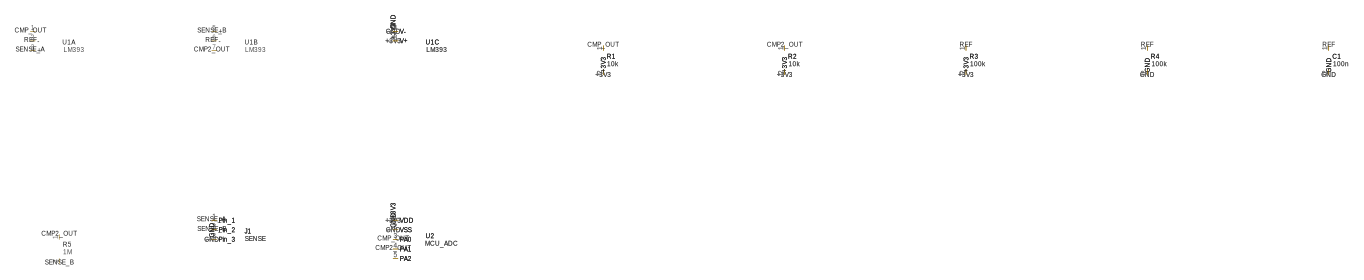
Each schematic below is in test_schematics/sources. The block under it is what berc check --only ANA-12 reports on it.
ana-12_comparator_hysteresis