PIN-3 Power outputs on connectors from nets used on board¶
| Severity | Status | Implementation |
|---|---|---|
| warning | runs in better_erc | easy, depends on NET-5 |
Data it needs: graph, part classes, rails.
Looks at. Connector pins on rails, the loads on the same rail.
What it catches. A connector pin that hands a board rail to the outside world (a header, an expansion connector, a sensor port) with nothing between the pin and the rail that the board's own parts run from, or only a slow polyfuse.
Why it matters. Whatever is plugged in can short the pin: a miswired cable, a dead adapter card, a probe slip. The short pulls down the rail the MCU runs on, so the board browns out instead of reporting the fault, and a polyfuse takes from milliseconds to seconds to trip, which is long enough to reset everything and sometimes to latch a regulator off.
Example. B200A J102 pin 1 +3V3_OUT is the +3V3_DCDC rail through polyfuse F102, pin 29 +5V0_OUT is VBUS through F101 (SMD1206B010, 100 mA hold, 300 mA trip). A short on pin 1 drags the MCU's own 3.3 V down until F102 heats up. Load switches were considered for rev B and dropped for lack of space; switching and current sense go on an optional power adapter instead (change list, 14 Oct 2026). That is a decision, and the check exists so it is made on purpose.
How to check. A connector pin on a rail of the power structure (NET-5) that also feeds on-board loads, where the path from the pin to the rail contains no IC (load switch, eFuse, current-limited switch): a graph query. Report the polyfuse-only case at a lower severity.
Fix. A current-limited load switch or eFuse per output (TPS2553, TPS25947 class), with its fault output read by the MCU; or a separate regulator for the outputs so a short does not touch the board's own rail.
References. SLVA862A §3.2 (overcurrent protection), §3.3 (short-circuit protection), §1 (PTC reaction time); Wikipedia, Resettable fuse.
Test schematics¶
Each schematic below is in test_schematics/sources. The block under it is what berc check --only PIN-3 reports on it.
pin-3_unprotected_outputs¶
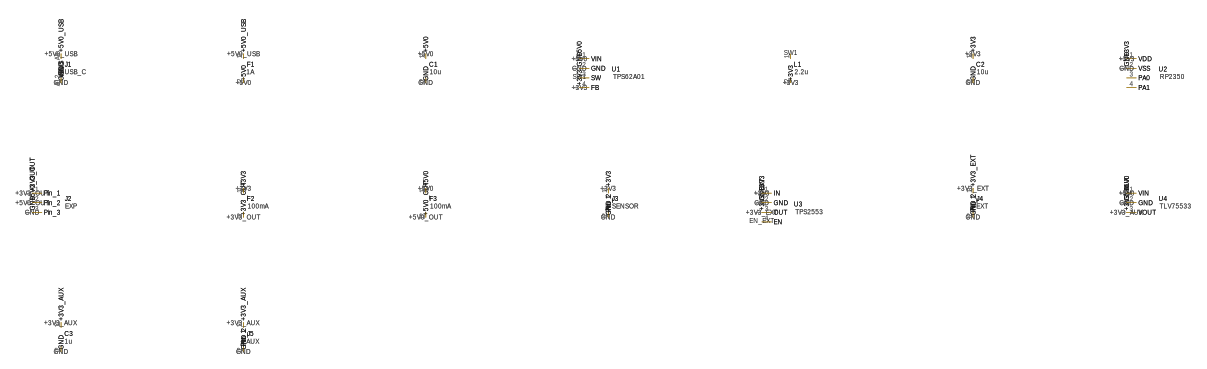
  warning    PIN-3 #1km     J3.1 (Pin_1) hands +3V3 out to the connector directly: a short there pulls down the rail U2 and U3 run from
                            net +3V3, pin J3.1
                            fix: a current-limited load switch or eFuse per output (TPS2553, TPS25947 class) with its fault output read by the MCU, or a separate regulator for the outputs
  suggestion PIN-3 #q99     J2.1 (Pin_1) hands +3V3_OUT out to the connector through F2 only: a short there pulls down the rail U2 and U3 run from
                            net +3V3_OUT, pin J2.1
                            fix: a current-limited load switch or eFuse per output (TPS2553, TPS25947 class) with its fault output read by the MCU, or a separate regulator for the outputs
  suggestion PIN-3 #fzd     J2.2 (Pin_2) hands +5V0_OUT out to the connector through F3 only: a short there pulls down the rail U1 and U4 run from
                            net +5V0_OUT, pin J2.2
                            fix: a current-limited load switch or eFuse per output (TPS2553, TPS25947 class) with its fault output read by the MCU, or a separate regulator for the outputs
PIN-3 also fires on the test schematics of other checks: wire-14_ground_pin_not_ground.