PIN-4 No overcurrent protection on a power input¶
| Severity | Status | Implementation |
|---|---|---|
| warning | runs in better_erc | easy, depends on NET-5 |
Data it needs: graph, part classes, rails.
Looks at. Power inputs, the parts in series with them.
What it catches. A power input with no fuse, polyfuse, eFuse or current-limited switch between the connector and the board.
Why it matters. When a part on the board fails short (a ceramic capacitor cracked in assembly, a regulator whose switch fused), the source delivers whatever it can: a lab supply its limit, a battery or a 24 V industrial supply tens of amperes. Traces fuse, connectors melt, the battery heats. A fuse turns that into a dead board with a known cause.
Example. A board running from a 2S Li-ion pack through a buck regulator, no fuse: a cracked 1206 input capacitor shorts the pack through a 0.3 mm trace, which glows and lifts before anything else stops the current.
How to check. Walk from each input pin (NET-5) to the first load; a part of class fuse (F designator, library class) or an IC the library marks as eFuse or current-limited switch must be on the way. Inputs from a source that limits by itself (a USB host port, a project setting) may be exempted.
Fix. A fuse or polyfuse sized per PIN-7, PIN-10, PIN-15, or an eFuse that also covers inrush and overvoltage.
References. SLVA862A §1 (fuses, PTCs and active protection), §2 (discrete protection circuits); Fuseology "Selection Factors" 4 and 5 (overload current, maximum available fault current).
Test schematics¶
Each schematic below is in test_schematics/sources. The block under it is what berc check --only PIN-4 reports on it.
pin-4_unfused_inputs¶
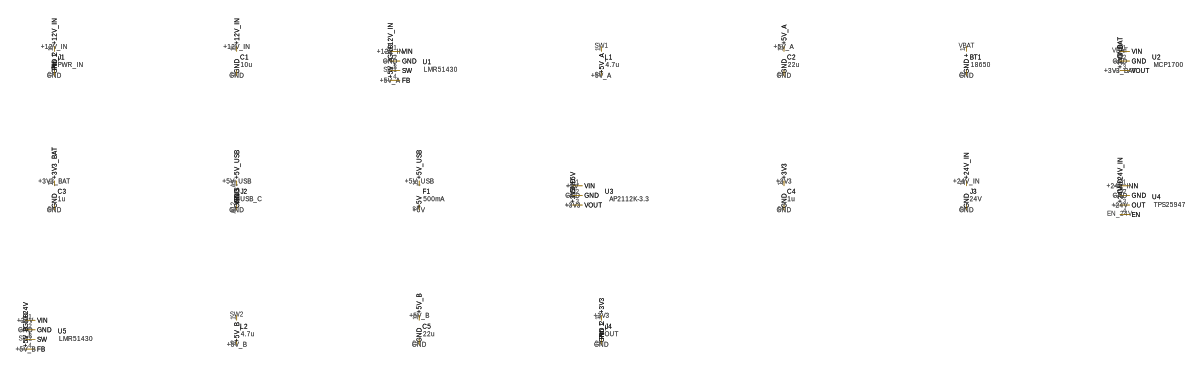
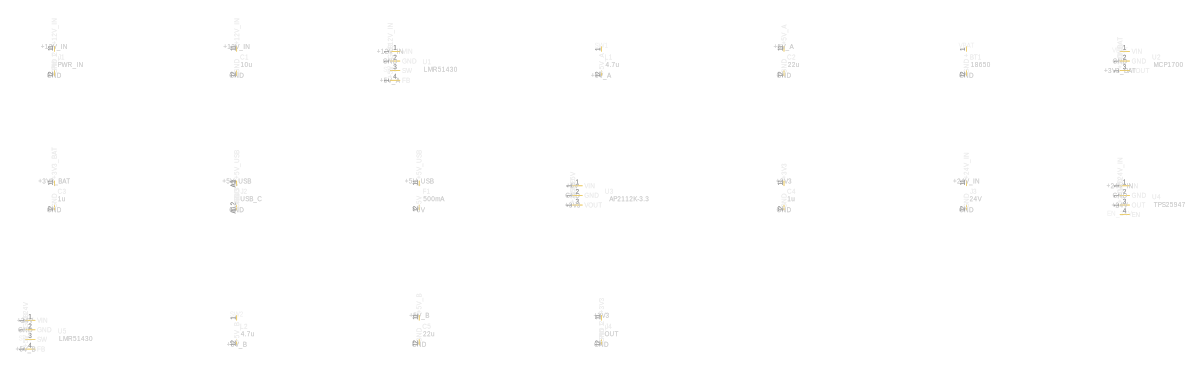
  warning    PIN-4 #h1d     power comes in on J1.1 (Pin_1) (+12V_IN) and reaches U1 with no fuse, polyfuse or eFuse on the way
                            net +12V_IN, pin J1.1
                            fix: a fuse or polyfuse sized per PIN-7, PIN-10, PIN-15 right after the connector, or an eFuse that also covers inrush and overvoltage
  warning    PIN-4 #2hw     power comes in on BT1.1 (+) (/VBAT) and reaches U2 with no fuse, polyfuse or eFuse on the way
                            net /VBAT, pin BT1.1
                            fix: a fuse or polyfuse sized per PIN-7, PIN-10, PIN-15 right after the connector, or an eFuse that also covers inrush and overvoltage
PIN-4 also fires on the test schematics of other checks: ana-10_opamp_feedback, bom-4_resistor_arrays, clk-14_push_pull_reset, conn-16_floating_shell, conn-17_look_alike_pinouts, conn-2_gpio_protection, dbg-10_crowded_rail, dbg-11_uart_spi_resistors, dbg-14_uart_console, dbg-16_heartbeat_led, dbg-17_swd_without_reset, dbg-18_bus_access, dbg-1_swd_not_connected, dbg-2_swd_series_resistors, dbg-3_no_leds, dbg-4_power_leds, dbg-7_enable_pulls, dbg-8_open_drain_pull_ups, dec-10_unsourced_bypass, dec-11_decade_apart, dec-1_no_decoupling, dec-4_ferrite_beads, dec-7_caps_per_pin, dec-8_source_side_caps, drv-12_base_resistor, drv-14_inductive_loads, drv-17_led_resistor, drv-5_inverter_gate_resistor, drv-6_back_to_back, drv-7_half_bridge_snubber, drv-9_relay_flyback, gnd-3_split_ground_joints, i2c-18_discrete_translator, i2c-18_isolated_segment, i2c-4_pull_up_to_signal, leak-1_rail_dividers, lvl-4_translator_pull_ups, lvl-7_several_rails, lvl-9_gate_reference, mem-1_sd_pull_ups, mem-3_clk_and_detect_pulls, pin-6_unfiltered_inputs, rail-18_parallel_regulators, rail-19_unfiltered_analog_supply, rail-1_unpowered_pins, rail-5_unsourced_rail, test-1_unconnected_pins, test-4_rail_test_points, test-5_bring_up_test_points.