RATE-9 Resistor voltage rating
| Severity | Status | Implementation |
|---|---|---|
| warning | runs in better_erc | mid, depends on NET-5, CFG-2, CFG-9 |
Data it needs: graph, part classes, parts snapshot.
Looks at. Voltage across each resistor, its maximum working voltage.
What it catches. A resistor with more voltage across it than its maximum working voltage, typically the top resistor of a divider from a high-voltage rail, or a bleeder across a high-voltage capacitor.
Why it matters. Small chip resistors have a voltage limit independent of their power rating: a high-value 0402 across 100 V dissipates almost nothing and still fails, by arcing across the short body or by slow drift as the film breaks down. High-value resistors reach the voltage limit long before the power limit, so the power check (RATE-2) alone misses them.
Example. A 1 MΩ / 10 kΩ divider measuring a 100 V bus with the 1 MΩ as a single 0402: 99 V across a part whose maximum operating voltage is 75 V in Vishay's MCS 0402 thin film series (and 50 V for many thick film 0402 series). Three 330 kΩ 0603 resistors in series share the voltage at 33 V each.
How to check. For each resistor, compute the voltage across it from the rails at its ends and the divider ratio (RPT-6); compare with the maximum working voltage from the MPN, or a default per package.
better_erc (erc_checks/src/rate/rate_9.rs) asks each MPN's rated voltage to be at least derating.resistor_v (1.25) times the working voltage. A part's Vreq_min field states the minimum rated voltage this board asks for, and replaces k times the working voltage: every MPN's rated voltage at least Vreq_min. Each rating must still exceed the working voltage itself, and a Vreq_min below the working voltage is a finding of its own. The working voltage is the part's Vworking field when it has one (switch nodes, transients, a part across two rails), else the larger difference between its two nets: a rail's range when the project states one ([nets] in the project file), its voltage otherwise, 0 V for a ground. A resistor inside a divider, with one end on a signal net, is judged only through its Vworking field until the divider ratio (RPT-6) feeds it. Each MPN field (Mpn1, Mpn2, ...) of a fitted part is judged on its own against the facts of the parts snapshot (parts.lock.toml). A miss is one finding per part and MPN field (item C4 Mpn2) naming the margin, with the hash of the inputs it rests on (the working value and how it is known, the MPN's rating, the derating factor) for a waiver. A rating the snapshot lacks is never a pass: the part gets one info finding naming each MPN and fact not checked. A part whose stress is not known is not judged.
Fix. Several resistors in series, larger packages, or parts specified for high voltage.
References. Vishay MCS/MCT/MCU/MCA datasheet (operating voltage Umax per size: 75 V for 0402, 100 V for 0603, 150 V for 0805, 200 V for 1206) (vishay.com/docs/28705).
Test schematics
Each schematic below is in test_schematics/sources. The block under it is what berc check --only RATE-9 reports on it.
rate-9_resistor_voltage
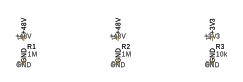
  warning    RATE-9 #prw    R1 Mpn1 RC0402FR-071ML: 50 V rated, 48 V working (+48V (48 V) to GND (0 V)), 1.04× < 1.25×
                            part R1, item R1 Mpn1
                            working V = 48 V (+48V (48 V) to GND (0 V)) (derived voltage from the net name)
                            Mpn1.rated_voltage = 50 (partdb parts.lock.toml RC0402FR-071ML rated_voltage (manual))
                            derating.resistor_v = 1.25 (derived default derating.resistor_v)
                            fix: several resistors in series, a larger package, or a part rated for the voltage
                            input in1:416b75dcf13d1900